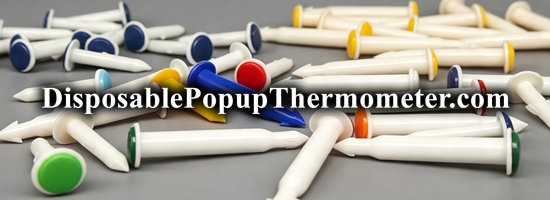
Food Grade Disposable Pop-Up Thermometer: Materials, Accuracy and Safety Standards Explained
Food Grade Disposable Pop-Up Thermometer: Materials, Accuracy and Safety Standards Explained
For food manufacturers and professional buyers, selecting a disposable pop-up thermometer is not only about price and availability. Product materials, temperature accuracy, and manufacturing standards directly influence reliability in real food processing applications.
A high-quality disposable cooking thermometer should provide stable temperature indication while meeting food contact requirements for professional use.
Understanding the materials and quality standards behind disposable pop-up thermometers helps global buyers choose a reliable supplier.
What Makes a Disposable Pop-Up Thermometer Food Grade?
A disposable pop-up thermometer is used together with food products during cooking or processing. Therefore, every component that contacts the food environment should be carefully selected and controlled.
Professional food temperature indicator manufacturers focus on:
- Food-grade material selection
- Stable production processes
- Consistent temperature activation
- International food contact requirements
Materials Used in Disposable Pop-Up Thermometers
A disposable pop-up thermometer is made from multiple components working together to provide reliable temperature indication.
Food Grade PA66 Nylon Housing and Core
The main housing and internal structure are produced using food-grade PA66 nylon, a material selected for its stability, durability, and suitability for food-related applications.
Using controlled food-grade materials helps maintain consistent product performance during cooking and processing.
Metal Spring Component
The internal mechanism uses a metal spring component designed to provide the necessary mechanical movement when the activation temperature is reached.
Professional manufacturers carefully control component quality to ensure stable operation.
Food Extracted Wax Sensing Medium
The temperature sensing element uses a food-extracted wax material designed to respond at specific activation temperatures.
The sensing medium is produced without heavy metals or soft metals and is designed for food-related applications.
Why Temperature Accuracy Matters
For commercial food companies, temperature indication consistency is an important quality factor.
A disposable pop-up thermometer should activate reliably according to the specified temperature point.
Important evaluation factors include:
- Activation temperature consistency
- Batch-to-batch stability
- Production process control
- Quality inspection procedures
Activation Temperature Customization
Different food products and markets may require different temperature indication points.
Professional OEM manufacturers can provide customized activation temperatures according to customer requirements.
Common applications include:
- Poultry cooking temperature indication
- Turkey roasting applications
- Chicken processing
- Meat product temperature monitoring
- Food safety programs
Understanding Disposable Temperature Indicator Quality Control
A reliable disposable temperature indicator manufacturer should maintain quality control throughout the production process.
Important quality management areas include:
- Incoming material inspection
- Production process monitoring
- Activation temperature testing
- Finished product inspection
- Export quality control
Food Safety Applications of Disposable Cooking Thermometers
Disposable cooking thermometers are widely used in professional food applications where consistent temperature indication supports production efficiency.
Typical applications include:
- Poultry processing plants
- Meat processing factories
- Frozen food manufacturers
- Ready meal producers
- Commercial roasting operations
Why Work With an Experienced Food Temperature Indicator Manufacturer?
A specialized manufacturer understands that disposable temperature indicators are not ordinary plastic products. They require precise component control, temperature calibration, and consistent manufacturing processes.
Experienced suppliers can better support:
- OEM projects
- Large bulk orders
- Custom activation temperatures
- Private label requirements
- Long-term supply programs
Manufacturing Experience Since 2006
LIOU Manufacturing – PopNReady Brand specializes in disposable pop-up thermometer production for global B2B customers.
Our products are manufactured with food-grade materials, controlled production processes, and flexible OEM customization capabilities.
One Product. Professional. Focused. 100% for Export.
Frequently Asked Questions
Are disposable pop-up thermometers food safe?
Professional disposable pop-up thermometers are manufactured using food-grade materials and designed for food-related applications.
What materials are used in disposable cooking thermometers?
Common components include food-grade PA66 nylon housing, metal spring components, and food-extracted wax sensing material.
How accurate are disposable pop-up thermometers?
A professional manufacturer should maintain consistent activation accuracy according to product specifications.
Can activation temperature be customized?
Yes. OEM manufacturers can customize activation temperatures according to customer requirements.
Are disposable temperature indicators used in food factories?
Yes. They are commonly used in poultry, meat processing, frozen food, and commercial cooking applications.
How do I choose a reliable food temperature indicator supplier?
Evaluate manufacturing experience, material control, quality systems, customization ability, and export capability.
DISCLAIMER: "Pop-Up Timer", "Disposable Pop-Up Timer", and "Disposable Pop-Up Thermometer" are generic industry terms used to describe single-use cooking temperature indication products. LIOU Manufacturing – PopNReady Brand is an independent direct-source manufacturer and is not affiliated with VOLK or any other third-party brand. Any references are provided only for identification, comparison, and application purposes.